Fo Guang University
Uedu Main Site
Explore Uedu
Student Console
Register as Member/Login
Research Informed Consent Center
Survey Center
Educational Big Data Challenge
Claim or create a course
Try an AI Scenario Task
Support & Messages
Uptime Data

UeduGPTs

--

Jupyters

9

Local AI

--

Uedu Code

--

佛光大學 AQI 36 20°C PM2.5 5
AI Reply Desktop Notifications

Show a desktop notification when the AI TA finishes replying

Chat Message Notifications

Notify me when classmates post messages in the forum

Sound notification

Play an alert sound whenever there is a new notification

UNDER DEVELOPMENT

Uedu Brain
Brain waves and blood oxygen sensing

A self-built multimodal physiological sensing device developed in stages: fNIRS and PPG are complete, and EEG integration is in progress. It explores real-time monitoring of cognitive load, attention and learning states.

fNIRS + PPG complete · EEG integration in progress
Uedu Brain · Multimodal probe PROTOTYPE
fNIRS Prefrontal oxygenation Δ µM
HbO₂ +0.42 HbR −0.15 Activation ↑
PPG Pulse · beat-to-beat intervals BBI → HRV
74bpm
HR
42ms
RMSSD
EEG Brain waves · band power Integration in progress
δ 0.5–4Hz 28
θ 4–8Hz 42
α 8–13Hz 58
β 13–30Hz 74
Prototype illustration · simulated signals; fNIRS and PPG hardware complete, EEG integration in progress

Prototype preview · simulated signals

From the headband to the companion robot

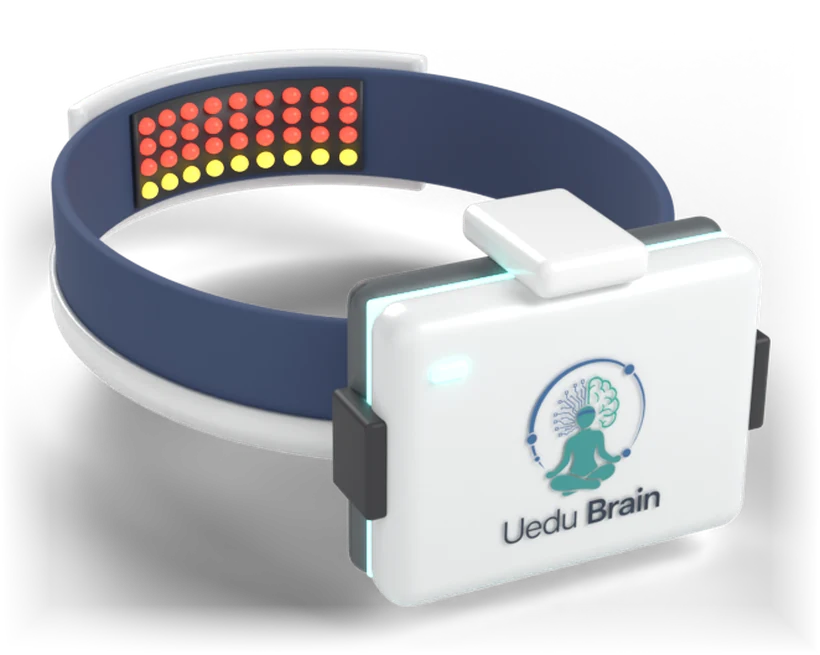
The Uedu Brain headband measures prefrontal blood oxygen and heartbeat, and Dudu, the companion robot, guides each measurement during interaction. Game events, headband signals and daily Garmin data share one timeline.

Uedu Dudu | Brain Fitness Companion Robot

AI companionship×Brain fitness interaction×Mind-body sensing×Cross-age applications
  1. 1Launched

    Uedu Studio

    Interactive content and AI application design platform

  2. 2In development

    Uedu Dudu

    Dudu: an AI companion character that interacts on screen

    Dudu waving hello

Uedu Brain headband

Mind-body sensing accessories (not part of the robot body)
3D concept image of the Uedu Brain headband
  • fNIRSPrefrontal blood oxygen changes
  • PPGHeartbeat intervals and heart rate variability
  • Task eventsEach game question’s timing aligned with the headband signal
  • Works with a Garmin watchActivity, heart rate, sleep
Older adults: brain fitness and daily records
  • Brain fitness games and cognitive recordsMemory, attention, executive function, reaction speed
  • Physiological and mind-body recordsHeadband: prefrontal blood oxygen, heartbeat intervals; watch: activity, heart rate, sleep
  • Daily companionship and careConversation, reminders, activity guidance
  • Anti-fraud and safe money useIn developmentDudu never asks for money or passwords; official 165 anti-fraud tips, AI voice scam alerts, money basics
Uedu Brain headband+ Garmin watch Older adults can use the headband and watch at the same time
Children: learning and active playPlanning

Dudu is a learning aid for children.

  • AI learning interactionKnowledge Q&A, scenario tasks, story creation
  • Exercise and activity recordsGarmin watch: activity, heart rate, sleep
  • Habit building and positive companionshipExercise, reading, daily routines
Garmin watch Children use only the watch: no cognitive tests and no headband
Overall advantages
Shared across agesOne platform, two uses for older adults and children
Sensing and recordingPhysiological and activity data from the headband and watch
User-defined content designDesign interactive activities in Uedu Studio
Multi-scenario applicationsHome, school, community, care locations
Cybersecurity and sovereign AIData stays in Taiwan, voice recordings deleted after transcription, headband made in Taiwan

Older adults decide who can see their data. For children, parents give consent and the child knows and agrees. The system does not diagnose and does not do emotion recognition.

Three sensing modules

Uedu Brain is developed in stages: the fNIRS and PPG modules are complete, and EEG module integration is in progress. The three complementary sensing technologies capture learners' brain and physiological activity from different angles.

Completed

fNIRS

Functional near-infrared spectroscopy Functional Near-Infrared Spectroscopy

Use near-infrared light to penetrate the scalp and measure haemoglobin oxygenation changes in the prefrontal cortex, indirectly reflecting brain-region activation and cognitive workload.

HbO₂ oxygenated haemoglobin HbR deoxygenated haemoglobin Prefrontal activation
Completed

PPG

Photoplethysmography

Optical sensors detect changes in blood vessel volume to calculate heart rate and heart rate variability (HRV), which reflect autonomic nervous system activity.

Heart rate HR HRV (RMSSD) BBI interval
Integration in progress

EEG

Electroencephalography

Measure brain potential activity via scalp electrodes and capture brain waves in different frequency bands such as α, β, θ and δ, reflecting levels of attention, cognitive load and relaxation.

Alpha wave (8-13 Hz) Beta wave (13-30 Hz) Theta wave (4-8 Hz) Delta wave (0.5-4 Hz)

Related research

IEEE SDS 2026

From Wearables to Classrooms: A Person-Centered Feasibility Study of HRV-Based Physiological Monitoring for Learning Analytics

Using consumer wearables in real university classes, we streamed beat-to-beat intervals (BBI), computed HRV metrics afterwards and analyzed them at the individual level. HRV responses to classroom events varied greatly between individuals, and group averages can mask individual patterns. The Uedu Brain PPG module follows the same approach: store only BBI, compute HRV afterwards, and analyze person by person.

Read research summary

IEEE EMBC 2026

C-GRASP: Clinically-Grounded Reasoning for Affective Signal Processing

Proposes a framework that brings the structure of clinical reasoning to physiological signal processing: when AI interprets physiological signals, each step maps to mechanisms validated in the medical literature, and the reasoning path can be reviewed by teachers, students and researchers. Uedu Brain will adopt this as its interpretation principle, keeping readings traceable and reviewable.

Read research summary

IEEE BigDataService 2025

An edge-deployed EEG sleep staging collaborative inference framework based on a local LLM

This study explores deploying an EEG sleep staging model on edge devices, combined with the reasoning capabilities of large language models (LLMs), to enable real-time, privacy-preserving sleep quality assessment. Uedu Brain's EEG module integration is in progress, and this study lays the groundwork for its edge computing and local inference.

Read research summary